
Jefferson County Court Records After Arrest
After a Jefferson County arrest, the jail record and the court record are connected but not the same record. Sheriff Zena Stephens' office operates the public jail tools that show booking data, arresting agency, booking charge text, bond fields, warrant numbers, and booking photos when the profile has an image. The person may also have an early first appearance where warnings, bond, and release conditions are addressed. The court record begins when the Jefferson County Criminal District Attorney, Keith Giblin, reviews the arrest and files a complaint, information, indictment, or other charging paper with the proper court. That filing turns the arrest event into a criminal case that can be tracked through clerk records.
The custody side belongs with jail inmate records, where current roster entries, the current inmate PDF, and jail-detail phone channels help confirm who is still in custody. Booking photos are a separate public-record issue covered by jail roster mugshots. Court records after a jail arrest focus on the charge as filed, the cause number, the clerk index, the judge or court when available, bond activity, warrants, and final disposition. A booking charge is an accusation at intake. It is not a conviction, and it may not be the same charge the DA later pursues.
Find Jefferson County Court Records
Jefferson County has more than one court-record channel. District felony and district-level criminal records route through the District Clerk, led by District Clerk Jamie Smith. The District Clerk criminal index allows district criminal searches by filing year, indictment number, or defendant name, but the inspected index showed visible years from 1981 through 2022 and excludes sealed or secured cases. A missing result in that older index does not prove that no court record exists.
County-level misdemeanor records route through the County Clerk, led by County Clerk Roxanne Acosta-Hellberg. The County Clerk record-location material says misdemeanor indexes run from August 6, 1951 to present, while court case data is updated three times daily. Images for misdemeanor, civil, and probate records are not online through that index, so a search may identify the case while still requiring clerk contact for copies. The Jefferson County Tyler Odyssey portal is attorney oriented; its notice said public access was not available through the portal at inspection.
The District Clerk criminal index page is the clearest county-specific search screen for district criminal cases. The image below comes from the official Jefferson County District Clerk criminal index.
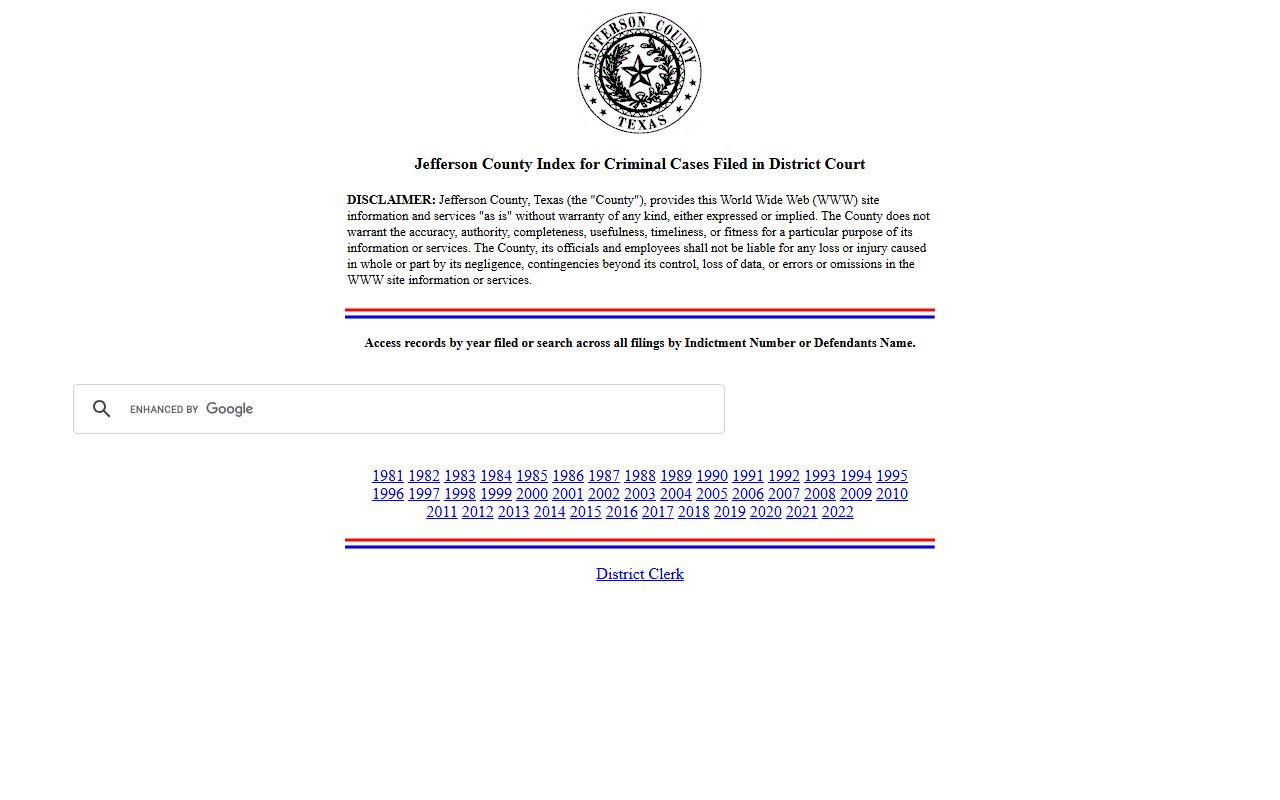
Use that index as a starting point for felony or district-level court records after an arrest, then verify newer, sealed, secured, or copy-only records with the clerk.
Jefferson County Court Search Fields
Search fields differ by system. The jail roster starts with current custody data, while court systems search by case, party, indictment, or index category. Public users should gather the name, booking date, arresting agency, charge description, degree, bond, and warrant number from the sheriff roster or current inmate PDF before searching the clerk channels. That detail helps separate people with similar names.
| Portal / Index | Field Label | Type | Required | Options / Format Notes |
|---|---|---|---|---|
| District Clerk Criminal Index | Year filed | link/list | optional path | Criminal cases accessible by filing year; visible years were 1981-2022. |
| District Clerk Criminal Index | Indictment number | text search | optional path | Searches district criminal filings by indictment number. |
| District Clerk Criminal Index | Defendant name | text search | optional path | Searches district criminal filings by defendant name. |
| Tyler Portal | Cause number | text | optional | Attorney portal; public access was not available at inspection. |
| Tyler Portal | Party | text | optional | Attorney portal search by party. |
| Tyler Portal | Date range | date range | optional | Attorney portal search by date range. |
| County Clerk records | Case/index type | index category | optional | Misdemeanor, civil, and probate index coverage differs by date range. |
Search After a Jefferson County Arrest
The cleanest search path starts with the arrest and then moves to the court. The sheriff's inmate search, current inmate PDF, and daily/current arrests PDF can show booking charge text before the court case is filed. Those sources can change fast, so court records after a jail arrest should be checked against the clerk source once the DA filing appears.
- Start with the sheriff roster or current inmates PDF and copy the person's name, arrest ID if shown, booking date, charge description, bond amount, bond conditions, and warrant number.
- Decide the likely court level. Felonies usually route to district court. County misdemeanors usually route to County Clerk records. Beaumont Class C, traffic, and ordinance cases may be municipal.
- Search the District Clerk criminal index by defendant name or indictment number for district criminal cases.
- Search or contact the County Clerk for misdemeanor court records, keeping in mind that misdemeanor index images are not online.
- For DA-held records, use the DA public-information channel at publicinformationJCDA@jeffersoncountytx.gov.
Texas also has statewide criminal-history rules, but a local court-record search is not the same thing as a regulated background check. A court file may show an accusation, a setting, a bond order, a dismissal, deferred adjudication, a plea, a verdict, or another disposition. It should be read by case status and court action, not by the fact of arrest alone.
Complaint, Information, and Indictment
Charges move from jail intake to court through a charging document. Keith Giblin's office represents the State of Texas and crime victims in criminal prosecutions from Class C misdemeanors through capital felonies. The DA may file the same charge shown at booking, file a different charge, reduce or amend a count, reject the case, or present a felony matter to a grand jury. These choices explain why the jail roster and court records after a jail arrest may not match word for word.
| Document | Who Uses It | Common Role | What to Check |
|---|---|---|---|
| Complaint | Law enforcement, prosecutor, or complaining witness process | States the accusation and can support early court action or misdemeanor filing. | Name, offense date, alleged conduct, and court level. |
| Information | Prosecutor | Formal charging paper often used for misdemeanor cases and some waived felony processes. | Filed charge, degree or class, cause number, and amendments. |
| Indictment | Grand jury | Formal felony accusation returned after grand-jury review. | Indictment number, counts, offense level, filing date, and later dispositions. |
Jefferson County Charge Status
Charge status is the bridge between the arrest record and the court record. A roster may show a booking charge with a degree code and bond amount. The court file may later show that the charge was filed, indicted, amended, reduced, dismissed, deferred, convicted, acquitted, or expunged. That status controls how the case should be understood.
| Status | What It Means | Why It Matters |
|---|---|---|
| Pending / filed | The accusation has been opened in court and has not reached final disposition. | Settings, bond orders, and attorney activity may still change. |
| Indicted | A grand jury returned a formal felony accusation. | The indictment can differ from the booking charge. |
| Amended / reduced | The prosecutor or court record reflects a changed charge, degree, or count. | Do not rely only on the original jail charge text. |
| Dismissed | The court record shows the charge was ended without conviction on that count. | Dismissal may support expunction review in some cases. |
| Deferred / convicted | The case resulted in deferred adjudication, plea, verdict, or judgment. | These outcomes have different public-record and criminal-history effects. |
| Acquitted / expunged | The person was found not guilty or qualifying records were removed through court process. | Public access may be restricted by court order or statute. |
Bond After Jail Arrest
Bond information appears in Jefferson County jail records before many court records are easy to find. The sheriff's current inmate PDF includes a Bond Amount column, a Warrant Num column, a Degree column, and the warning that all data is subject to change. It also says bond and fees must be paid with exact cash and directs people to call 409-726-2540 for details. Court records may later show bond settings, bond changes, bond conditions, capias activity, or no-bond holds.
| Bond Type | How It Works | Record Clue |
|---|---|---|
| Cash bond | Money is paid directly when accepted by the proper authority. | The roster or PDF may list a dollar bond amount. |
| Surety bond | A licensed bail bond company posts the bond under Texas rules. | The company will need exact name, charge, and bond details. |
| Personal bond / PR | Release is based on a written promise to appear and court conditions. | The court file is the better source for terms. |
| No-bond hold | Release is blocked by a hold, warrant, detainer, or court order. | Call the jail before assuming one posted bond clears all custody issues. |
Note: A detainer is a hold or request from another agency, and it can prevent release even when the local bond looks payable.
Jefferson County Arrest Warrants
No official countywide public warrant-search portal was located in the reviewed Jefferson County sheriff pages. The sheriff site has a Most Wanted feature, and official search text identified Warrant Clerks at 409-835-8453, but that is not the same as a searchable public warrant database. If a warrant leads to booking, the inmate may appear on the sheriff roster and the current inmate PDF may show a warrant number.
The clearest official online warrant list found was for Beaumont Municipal Court. That list is limited to city Class C, ordinance, and traffic-type matters and gives 409-980-7200 for municipal court. County felony and misdemeanor warrant questions should be confirmed through the sheriff warrant phone route, the District Clerk, the County Clerk, or counsel tied to the case.
Charges, Convictions, Sealing, Expunction
Two comparisons matter in court records after a jail arrest. First, a charge is not a conviction. Second, a sealed record is not the same as an expunged record. Texas Government Code Section 411.074 addresses nondisclosure conditions for certain records, while Texas Code of Criminal Procedure Chapter 55 governs expunction. Eligibility depends on the exact case outcome and court order.
| Point | Charge | Conviction |
|---|---|---|
| Stage | An accusation after arrest, complaint, information, or indictment. | A final result through plea, verdict, or judgment. |
| Proof | Based on probable cause or prosecutor filing standards. | Requires plea or proof beyond a reasonable doubt at trial. |
| Record Meaning | May be pending, amended, reduced, dismissed, or rejected. | May affect sentence, supervision, custody, or later criminal history. |
Sealing and expunction also have different effects under Texas law.
| Point | Sealed / Nondisclosed | Expunged |
|---|---|---|
| Public visibility | Hidden from many public searches by court order. | Removed or destroyed for qualifying arrest records. |
| Legal source | Texas Government Code Section 411.074 and related nondisclosure law. | Texas Code of Criminal Procedure Chapter 55. |
| Access after order | Some criminal justice or authorized entities may still see limited data. | Access is much more restricted, subject to the expunction order. |
Restricted Court Records After Arrest
Texas public-information law supports access to public government records, but it also has limits. Texas Government Code Chapter 552 is the Texas Public Information Act. Law-enforcement and prosecutor records can be withheld when release would interfere with detection, investigation, or prosecution, although basic information about an arrested person, an arrest, or a crime remains important under Section 552.108(c). Juvenile records, sealed files, secured court files, expunction orders, nondisclosure orders, and redactions can all affect what the public can see.
Important: Court, jail, and search records are not consumer reports and may not be used for FCRA-covered decisions.